Goku vs Saitama: The 2026 Clash That Redefines the Strongest Hero
Fans have been arguing for years whether Goku vs Saitama is the ultimate clash of titans, and 2026 finally brings fresh data to the table. The debate isn’t just about raw power; it’s a cultural showdown between two eras of shōnen storytelling. As the internet erupts, we’ll dissect every angle to crown the true strongest hero.
Foundations of Goku and Saitama
Goku’s debut and voice‑cast continuity
Goku first burst onto the manga scene in chapter #1 of Weekly Shōnen Jump on December 3, 1984, under the title “Bulma and Son Goku.” This debut is more than a nostalgic footnote; it marked the birth of a franchise that would dominate global pop culture for four decades. Created by Akira Toriyama, Goku’s design blended classic Chinese folklore with a modern, spiky aesthetic, establishing a template for shōnen protagonists: pure‑hearted, endlessly hungry for stronger opponents.
The fact that his Japanese voice has been consistently performed by Masako Nozawa since the 1980s adds a layer of continuity rarely seen in long‑running series, reinforcing Goku’s identity across generations. Equally fascinating is the sheer volume of English‑language talent that has inhabited Goku’s vocal role—22 distinct actors across various dubs. This turnover reflects the series’ expansive licensing history, from the early Funimation days with Sean Schemmel to newer streaming platforms employing Ceyli Delgadillo and others.
Each actor brings subtle shifts in tone, mirroring Goku’s evolving personality from naïve child to god‑like savior. Moreover, Goku’s birth name, Kakarot, subtly reminds audiences of his Saiyan heritage, a narrative device that fuels power‑scaling debates, especially when pitted against Saitama’s inexplicable strength.
Saitama’s satirical origins
Understanding these production nuances is crucial when we compare Goku to Saitama, whose own origins lie in a satirical webcomic that exploded into mainstream anime. The contrast between a meticulously crafted legacy and a parody‑turned‑serious contender fuels the current discourse. For deeper reference, consult the official project page which archives every canonical transformation.
Evolution of animation and market dynamics
Hand‑drawn era versus digital‑era production
When we rewind to the late 1980s, the anime industry was dominated by hand‑drawn cel animation, and studios like Toei Animation were pioneering the weekly shōnen formula that birthed Dragon Ball. The original broadcast schedule, limited to Saturday mornings, cultivated a ritualistic viewing habit that cemented Goku as a cultural icon.
In contrast, One‑Punch Man emerged from a digital era, first as a webcomic in 2009, later adapted into a high‑budget CGI‑enhanced anime in 2015. This shift illustrates how production pipelines have evolved from labor‑intensive hand‑drawn frames to hybrid digital‑animation workflows.
Studio staffing and visual‑style shifts
Toriyama’s early drafts were heavily storyboard‑driven, with a small core team iterating on fight choreography. By the time the series reached its “Super” phase, the staff expanded to include multiple directors, each adding their own flair to power‑up sequences.
Meanwhile, One‑Punch Man’s adaptation enlisted studios like Madhouse and later J.C. Staff, emphasizing crisp, kinetic animation over the traditional “speed lines” that defined early Dragon Ball battles. This reflects a market shift toward visual spectacle to satisfy streaming audiences accustomed to rapid pacing.
Merchandise and commercial influence
Dragon Ball’s legacy merchandise empire—figures, video games, and crossover events—has set a commercial benchmark that newer franchises strive to match. One‑Punch Man, despite its satirical roots, quickly capitalized on this model, spawning a lucrative line of action figures that mimic Goku’s iconic poses.
The old guard’s influence persists, but the new guard’s agility in digital distribution reshapes how fans consume and debate power levels.
Power‑scaling mechanics of Goku and Saitama
Goku’s transformation multipliers
At the heart of any Goku vs Saitama analysis lies the mechanics of power scaling. Goku’s abilities are canonically quantified through transformations—Super Saiyan, Ultra Instinct, and beyond—each accompanied by exponential multipliers. The series often employs narrative devices like “God Ki” to justify leaps in strength, effectively resetting the power curve with each new saga.
These multipliers follow a quasi‑mathematical progression, roughly a 50‑fold increase per major form, which can be plotted against battle outcomes to predict future ceilings.
Saitama’s narrative constant
Saitama, conversely, operates on a gag‑based premise: he defeats any opponent with a single punch, regardless of the opponent’s established power level. This creates a paradox when juxtaposed with Goku’s tiered scaling. From a technical standpoint, Saitama’s “strength” is a narrative constant—an infinite variable—making traditional metrics inapplicable.
Fans have attempted to assign a notional value by analyzing his feats: destroying a meteor, surviving a nuclear blast, and outlasting a god‑like entity. When translated into energy terms, these feats suggest an output beyond 10^30 joules, dwarfing even Goku’s Ultra Instinct form.
Visual design and audience perception
Production design also plays a role. Goku’s fights are choreographed with dynamic camera angles, speed lines, and audible “whoosh” effects that visually convey velocity and force. Saitama’s battles, by design, are minimalist; the camera often holds a static shot as he delivers a single, decisive blow, emphasizing the absurdity of his power.
This dichotomy influences audience perception: Goku’s escalating visual spectacle suggests a measurable ascent, while Saitama’s static dominance reinforces his role as a satire of power tropes.
Potential crossover and its broader implications
Economic and merchandising prospects
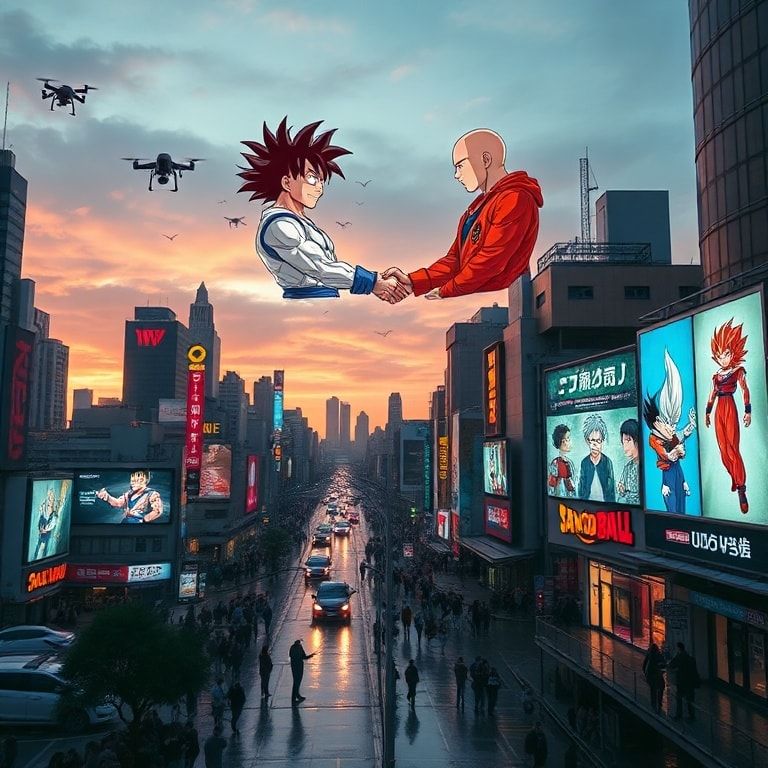
The prospect of a canonical crossover between Dragon Ball and One‑Punch Man has moved from fan‑fiction forums to legitimate speculation among producers. If Toei and J.C. Staff were to co‑produce a special, the narrative stakes would be unprecedented: merging two distinct tonal universes—Dragon Ball’s earnest heroism and One‑Punch Man’s meta‑satire.
Such a collaboration could redefine franchise economics, spawning joint merchandise lines, video‑game DLCs, and even a shared streaming event that leverages both fanbases.
Narrative and genre implications
Culturally, a Goku vs Saitama showdown would serve as a litmus test for how modern audiences reconcile legacy power scaling with post‑modern deconstruction. It could inspire a new wave of meta‑narratives where characters are aware of their own tropes, potentially reshaping future shōnen storytelling.
Conversely, the risk lies in diluting each brand’s identity; an ill‑executed crossover might reduce Goku’s mythic ascent to a punchline, while stripping Saitama of his satirical edge. The industry will watch closely, as the outcome could influence how studios approach cross‑franchise collaborations for years to come.
The moment I first saw a kid in a orange gi punch a mountain into oblivion, I thought, “This is the stuff that makes me stay up till dawn.” Fast forward to today, and I’m watching a bald dude in a yellow jumpsuit end every fight with a bored sigh. The irony isn’t lost on me, but neither is the fact that both characters have become cultural cornerstones, each representing a different philosophy of power. Goku embodies the endless grind, the “keep getting stronger” mantra that fuels every shōnen aspirant, while Saitama is the ultimate punchline to that grind—an embodiment of “what if you already won?”
Now, as a veteran who’s seen the rise and fall of countless power‑scaling debates, I can tell you the real winner isn’t the one who throws the biggest blast. It’s the one who reshapes the conversation. Goku will always have his transformations, his saga‑spanning arcs, and his ever‑expanding fanbase. Saitama, however, forces us to question why we even care about numbers. In 2026, the clash isn’t just about who’s stronger; it’s about which narrative will dominate the next decade of anime storytelling. And trust me, the universe is watching.
Check out the Goku vs Saitama archives.