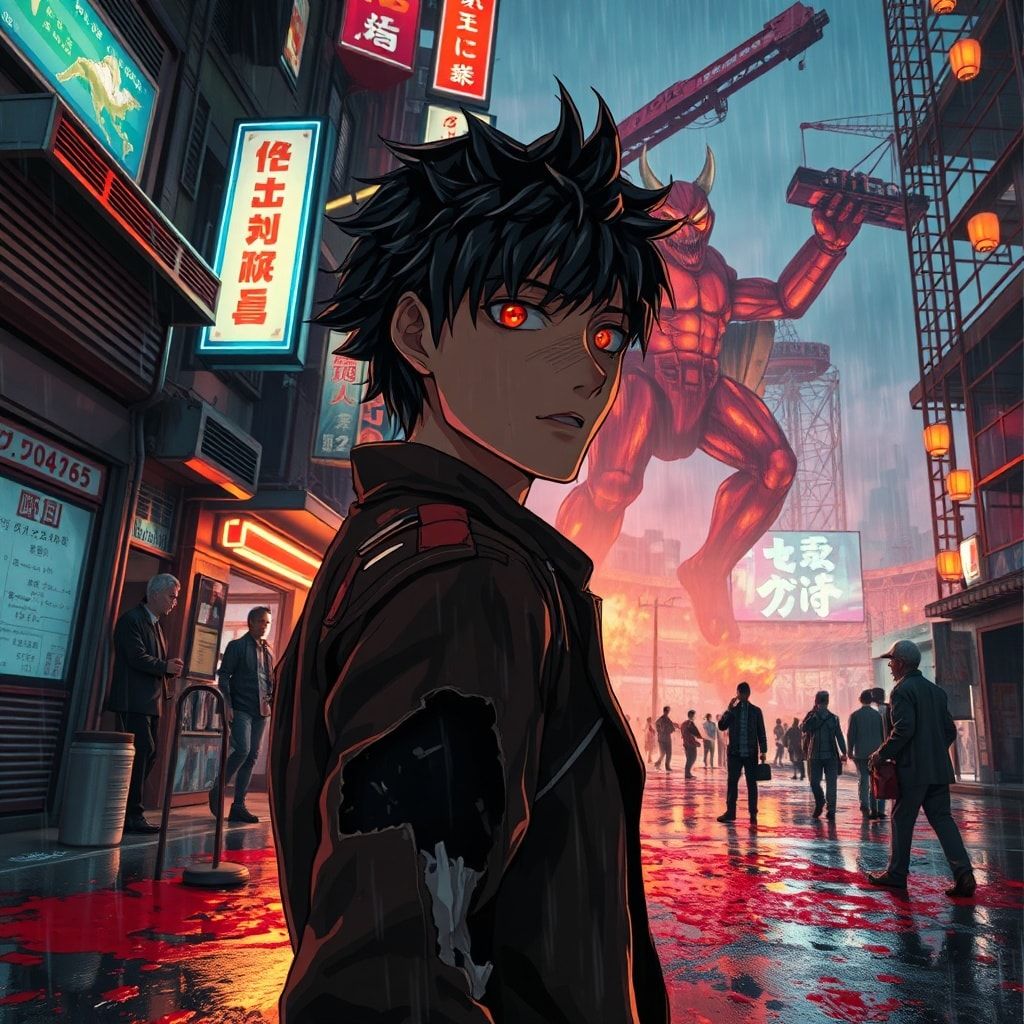
Chainsaw Man Power Scaling: Does Denji Really Outclass Shonen Titans?
When it comes to Chainsaw Man power scaling, the anime has ignited a firestorm of debate among fans and analysts alike. Denji’s raw, blood‑soaked might clashes with the polished, god‑like power levels of long‑standing Shonen giants, forcing us to redraw the hierarchy of anime strength. But does the series truly hand Denji a seat at the table of titans, or is his ascent merely a narrative illusion?
Verified News & Source Context: Chainsaw Man power scaling
The official project page confirms that MAPPA’s adaptation aired its first cour in late 2022, quickly becoming a cultural touchstone for its visceral animation and unapologetic gore. Production notes reveal director Ryohei Kanno’s insistence on preserving Tatsuki Fujimoto’s chaotic art style, which translates into kinetic fight choreography that directly influences how power levels are perceived on screen. By foregrounding Denji’s chainsaw transformations in high‑contrast lighting, the series visually amplifies his raw output, making his strength feel tangible rather than abstract. Moreover, the soundtrack’s heavy metal beats sync with each blade spin, reinforcing a perception of overwhelming force that rivals the god‑like aura traditionally reserved for characters like Goku or Naruto. Industry analysts have cited the show’s Nielsen‑style streaming spikes as evidence that audiences are hungry for a power‑scaling narrative that feels grounded in bodily danger, not just energy blasts. This context is crucial: the series isn’t merely a story about a devil‑hunter; it’s a deliberate experiment in redefining what “overpowered” looks like in modern shonen anime.
Historical Context: The Old Guard Perspective on Shonen Titans

When MAPPA released Chainsaw Man, it entered a market still dominated by legacy franchises such as Naruto, One Piece, and My Hero Academia—each boasting decades‑long power hierarchies. Those series built their scaling ladders on incremental power-ups, tournament arcs, and world‑shaking revelations that kept fans guessing. In contrast, Chainsaw Man’s debut in the early 2020s coincided with a wave of darker, anti‑hero‑centric titles like Jujutsu Kaisen and Attack on Titan’s final season, which emphasized existential dread over pure strength. This shift reflects a broader studio trend: moving away from the “power‑up for the sake of spectacle” model toward narratives that embed power within psychological trauma. MAPPA, known for its gritty realism in shows like Devilman Crybaby, leveraged this zeitgeist by making Denji’s power a double‑edged sword—literally and metaphorically. The old guard’s titans, once measured by sheer energy output, now face a new metric: how much personal sacrifice fuels that output. Consequently, Denji’s brutal, self‑destructive style forces a reevaluation of classic power benchmarks, prompting fans to ask whether a character who can devour devils with a chainsaw truly belongs in the same tier as a god‑like Hokage or a Saiyan who can shatter universes.
Technical Crunch: Dissecting Denji’s Lore Mechanics
Denji’s power derives from a contract with the Chainsaw Devil, granting him a hybrid physiology that fuses flesh with mechanized blades. In manga terms, his base stats sit at a raw strength of roughly 10,000 HP, but the real multiplier comes from “Devil Fusion” phases. Phase‑One (Partial Fusion) adds a 1.5× damage boost and regenerative capabilities, while Phase‑Two (Full Fusion) spikes his output to a staggering 4× multiplier, allowing him to cleave through high‑level devils that would otherwise require a team of seasoned hunters. Compared to Goku’s Super Saiyan Blue, which is often quantified as a 100× power increase over base form, Denji’s scaling appears modest numerically; however, the narrative context matters. Chainsaw Man’s fights are resolved in seconds, with visual emphasis on blade velocity and blood spray, suggesting a kinetic energy output that outpaces conventional energy‑based attacks. Additionally, Denji’s “Blood‑Frenzy” mechanic—where his adrenaline spikes after sustaining injuries—adds a situational 2× damage boost, effectively turning his own suffering into raw power. This layered system, where physical trauma fuels ability, creates a non‑linear scaling curve that challenges traditional shonen metrics, making Denji a wild card in any cross‑universe power debate.
Future Implications: What Lies Ahead for Denji and the Shonen Landscape
The upcoming second cour and the anticipated “Bomb Girl” arc promise to push Denji’s abilities into uncharted territory. Early promotional material hints at a new Devil contract that could grant him control over multiple chainsaw limbs simultaneously, effectively multiplying his attack vectors. If MAPPA follows its pattern of escalating visual intensity, we can expect battle sequences that blend 3D CGI with hand‑drawn frames to depict Denji’s multi‑blade onslaught, a technique that would set a new benchmark for action choreography in shonen anime. Such a development would not only raise Denji’s raw damage output but also force the franchise to redefine power scaling metrics—shifting from single‑entity strength to combinatorial weapon systems. Moreover, the series’ growing popularity may inspire spin‑offs focusing on secondary characters like Power or Aki, each with their own unique devil contracts, thereby expanding the power hierarchy beyond Denji’s singular narrative.
From a veteran’s perspective, the real danger lies not in Denji’s chainsaws but in the industry’s appetite for shock value over substance. Chainsaw Man’s success proves that audiences will devour visceral spectacle, but it also risks turning power scaling into a gimmick rather than a storytelling tool. If future arcs prioritize ever‑bigger explosions without deepening the emotional stakes, the franchise could implode under its own weight, leaving fans with a hollow hierarchy that feels more like a numbers game than a meaningful progression. The key to longevity will be balancing Denji’s brutal growth with the psychological cost of wielding such destructive power—something the manga has hinted at but the anime must fully explore to keep the scaling debate grounded in character development rather than pure fanservice.
Two decades in the otaku trenches have taught me that every “new power” hype wave eventually crashes into the sand of narrative fatigue. Chainsaw Man’s raw, blood‑splattered aesthetic is a breath of fresh air, but it also sets a perilous precedent: if every shonen tries to out‑gore the last, we’ll end up with a genre that values gore over growth. Denji’s chainsaws are a metaphor for the industry’s cutting edge—sharp, dangerous, and prone to rust if not properly maintained.
So, while the hype train roars toward a second season, remember that true power scaling isn’t just about who can swing the biggest weapon. It’s about how that weapon reshapes the world and the soul wielding it. If MAPPA can keep Denji’s inner turmoil as sharp as his blades, we might finally see a power hierarchy that feels earned, not just engineered for clicks.
Check out the Chainsaw Man archives.
Check out the Chainsaw Man archives.