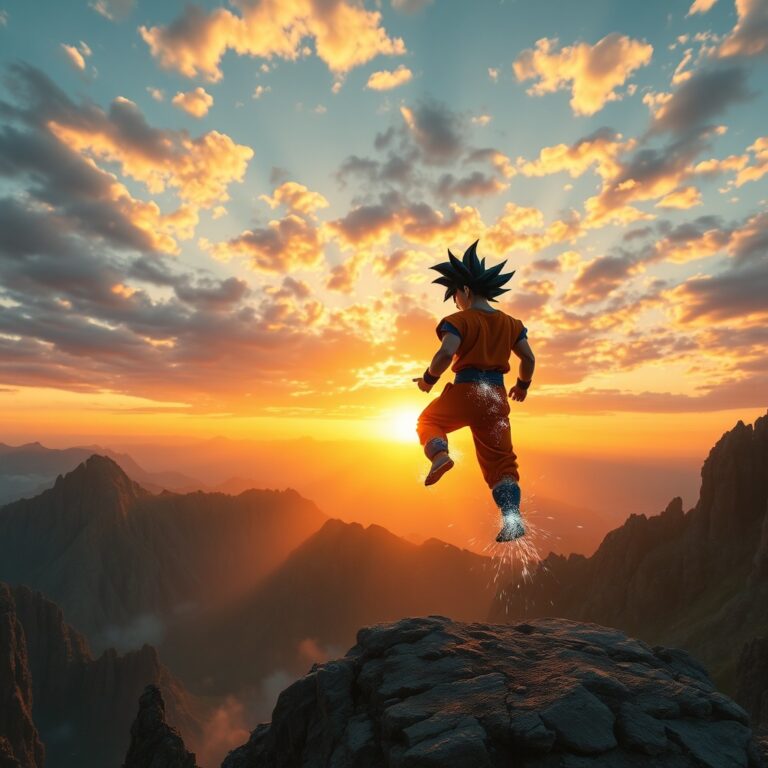
Dragon Ball power scale Unleashed: Does Goku’s Ultra Instinct Really Outclass the Gods?
The Dragon Ball power scale has become the holy grail for fans who love to argue over who truly reigns supreme. With Goku finally cracking the Ultra Instinct barrier, the series forces us to rethink the limits of mortal and divine might. But does his newfound reflexive mastery actually eclipse the omnipotent beings that govern the multiverse?
Verified News & Source Context: The Foundations of the Dragon Ball power scale
The official project page confirms that the Dragon Ball Super anime ran from July 2015 to March 2018, delivering a 131‑episode saga that re‑energized the franchise after a decade of stagnation. This broadcast window coincided with a global streaming boom, allowing the series to reach new markets via platforms like Crunchyroll and Netflix, which in turn amplified fan discourse around power levels. Parallelly, the manga, now collected into 24 tankōbon volumes, has provided a more granular expansion of the lore, often outpacing the anime in terms of raw power revelations. Central to the multiversal hierarchy is Zenō‑sama, the enigmatic Lord of Everything, whose casual dismissal of entire universes sets a benchmark that dwarfs even the most god‑like mortals. The Tournament of Power, a reality‑bending battle royale featuring ten‑person squads from eight of the twelve universes, culminated in Android 17’s unexpected victory for Universe 7, underscoring the narrative’s willingness to subvert expectations. Goku’s breakthrough into Ultra Instinct‑Sign during this tournament marked a pivotal moment: a reflexive state where the body moves without conscious thought, effectively turning defense into offense. This milestone reshaped the Dragon Ball power scale, introducing a qualitative leap that cannot be measured merely by numerical multipliers, but rather by a conceptual shift in what it means to be a combatant in a multiversal arena.
Historical Context: Old Guard Perspective on Power Scaling
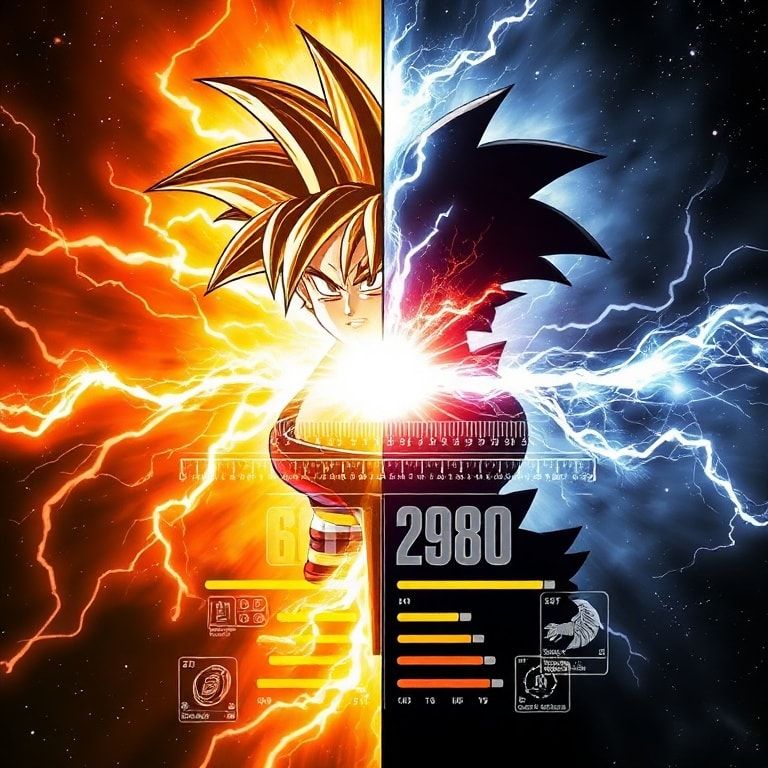
To appreciate the seismic impact of Ultra Instinct on the Dragon Ball power scale, one must first revisit the series’ earlier epochs. In the original Dragon Ball (1986‑1989) and its successor, Dragon Ball Z (1989‑1996), power was quantified through overt visual cues: aura intensity, explosive energy blasts, and the infamous “power level” readouts. The Saiyan saga introduced exponential growth, yet the ceiling remained tethered to the concept of “Super Saiyan” transformations, each a predictable tier. Studio Pierrot’s production pipeline during the Z era emphasized hand‑drawn dynamism, but budget constraints often limited the visual fidelity of higher‑tier battles. The shift to Dragon Ball Super marked a departure: the staff, now led by seasoned veterans like Masako Nozawa and newcomers such as Tetsuro Kodama, embraced digital compositing, allowing for more intricate aura designs and fluid motion that could visually convey the abstract nature of Ultra Instinct. Market trends also played a role; the rise of online forums and YouTube analysis videos forced the franchise to address fan‑driven power scaling debates head‑on, leading to narrative choices that explicitly showcase god‑level entities like Beerus and Whis. Consequently, the series transitioned from a primarily narrative‑driven power escalation to a meta‑aware, self‑referential discourse that acknowledges its own mythos, thereby redefining the parameters of the Dragon Ball power scale for a new generation of otaku.
Technical Crunch: Dissecting the Dragon Ball power scale Mechanics

At its core, the Dragon Ball power scale is a composite of narrative logic, in‑world physics, and artistic exaggeration. Ultra Instinct‑Sign operates on the principle of “mushin” (no‑mind), allowing the fighter’s subconscious to dictate movement, effectively bypassing the latency of conscious decision‑making. This translates into a measurable increase in reaction time, estimated by fans to be on the order of milliseconds—a factor that, when multiplied across the rapid exchange of blows in a tournament setting, yields a de facto damage output multiplier far exceeding conventional transformations. Zeno’s authority, however, introduces a non‑linear variable: his ability to erase entire universes with a thought renders any conventional ki‑based metric moot. In practical terms, the series employs visual shorthand—blinding white flashes, omnipresent silence, and a sudden shift to a minimalist background—to signal a power level that transcends quantifiable limits. Moreover, the manga’s recent chapters have hinted at “Godly Ki” as a distinct energy type, with its own resistance coefficients and amplification ratios, further complicating the scale. Production designers leverage these concepts by layering multiple aura textures, each representing a different energy tier, and by employing motion‑blur algorithms that simulate the distortion of space-time around ultra‑fast movements. This technical choreography not only serves aesthetic purposes but also reinforces the narrative claim that Ultra Instinct is a paradigm shift, redefining what the Dragon Ball power scale can encapsulate.
Future Implications: Where the Scale Might Lead
The introduction of Ultra Instinct as a viable, albeit unstable, form opens a plethora of narrative avenues for the franchise. Future arcs could explore the systematic training required to master the “Complete” Ultra Instinct, potentially introducing new mentors, perhaps even drawing from the forgotten pantheon of Kaiōshin. Such a progression would naturally expand the Dragon Ball power scale, establishing a hierarchy where mortal fighters can rival, or even surpass, the omnipotent overseers like Zeno, thereby reshaping the power dynamics of the multiverse. Additionally, the commercial success of the Tournament of Power has demonstrated a market appetite for high‑stakes, cross‑universal battles, suggesting that upcoming adaptations—whether anime, manga, or even video game crossovers—will likely double down on expansive power scaling, integrating mechanics that allow players to experience Ultra Instinct in real time. This could also spur a wave of fan‑generated content, from speculative power charts to fan‑fiction that pits Goku against deities from other franchises, further cementing the series’ cultural relevance.
Listen, kid, the moment Goku slipped into Ultra Instinct‑Sign, the entire power‑scaling community went into a frenzy that could’ve powered a small nation. I’ve seen every hype train from Super Saiyan 3 to Super Saiyan God, and let me tell you, none of those transformations felt as… existential as this. It’s not just a new tier; it’s a philosophical rewrite that says, “Hey, maybe the universe isn’t a ladder you climb, but a maze you navigate with instinct.” That’s a level of narrative audacity that makes even the old‑school purists squint.
But don’t get cocky, because the gods are still watching from their celestial balconies, sipping on whatever immortal brew they prefer. Zeno’s casual “erase” button still looms like a cosmic guillotine, and any fan who thinks Ultra Instinct alone can topple that hierarchy is living in a delusion as flimsy as a paper‑thin power chart. The real story will be how the writers balance this newfound reflexive power with the ever‑present threat of omnipotence, and whether Goku can actually sustain that state without turning into a walking, talking plot device. Keep your eyes peeled, because the next arc will either cement Ultra Instinct as the pinnacle of mortal achievement or smash it back into the dust of over‑hyped gimmicks.
Check out the Dragon Ball Super archives.
Check out the Dragon Ball Super archives.