
Goku vs Saitama: Who Really Wields the Ultimate Power Crown?
Ever wondered whether the Saiyan legend or the bald‑capped punchline truly owns the throne of raw might? Goku vs Saitama has become the internet’s favorite thought experiment, pitting decades of shōnen escalation against a single‑stroke satire. The outcome could reshape how we measure power in anime forever.
Verified News & Goku vs Saitama Source Context

Goku first exploded onto the manga scene in chapter #1 “Bulma and Son Goku,” dated December 3 , 1984, in Weekly Shōnen Jump issue #51. That debut anchored a franchise that now spans five major anime series—Dragon Ball, Dragon Ball Z, Dragon Ball GT, Dragon Ball Super, and Dragon Ball Daima—each expanding his mythos and commercial reach. The continuity of Masako Nozawa’s Japanese voice work provides a rare anchor in a sea of dub variations; across English‑language releases, at least twenty‑two actors have taken the mantle, from Sean Schemmel to Philece Sampler, reflecting both localization trends and the franchise’s global elasticity. Goku’s species, the Saiyan, and his dual occupation as martial artist and radish farmer, embody the series’ blend of cosmic stakes and humble roots, a formula that fuels endless power‑scaling debates. The official project page chronicles these milestones, underscoring why any comparison with Saitama—a character designed to satirize such escalation—carries weight beyond fan speculation.
Historical Context – Old Guard Perspective
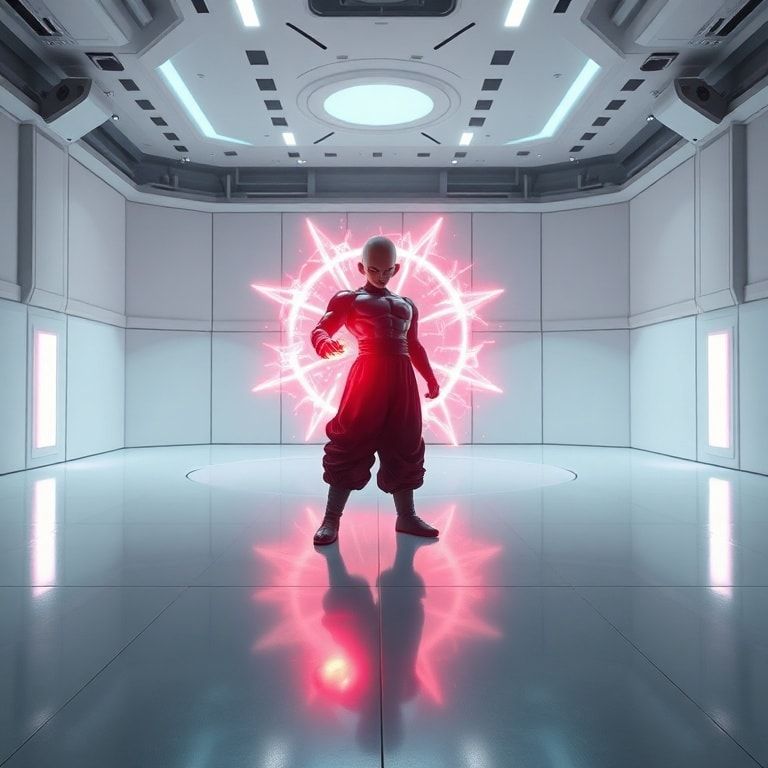
When Dragon Ball first aired in the mid‑80s, the shōnen landscape was dominated by muscular heroes and clear‑cut power ladders. Studios like Toei Animation pioneered the “power‑up” visual shorthand that would become a genre staple. Fast forward to 2015, One‑Punch Man arrived as a web‑comic turned anime, deliberately subverting those tropes with Saitama’s omnipotent, bored demeanor. The contrast is not merely narrative; it reflects a shift in production philosophy. Early Dragon Ball episodes relied on hand‑drawn cel animation, limited frames, and dramatic pauses to emphasize Ki blasts. By the time Super and Daima rolled out, digital compositing allowed hyper‑dynamic fight choreography, making Goku’s transformations feel like a visual arms race. Meanwhile, Saitama’s fights are intentionally minimalist—single punches, dead‑pan reactions—highlighting a meta‑commentary on the genre’s excess. Studios have responded by embracing both extremes: high‑budget spectacle for legacy franchises and low‑budget satire for newer entries, a duality that fuels the Goku vs Saitama debate and illustrates how market demands shape storytelling aesthetics.
Technical Crunch – Lore Mechanics Explained
At the heart of the showdown lies a clash of metaphysical rule‑sets. Goku’s power is quantified through Ki, a manipulable life‑force that scales with training, transformation, and emotional triggers. His Super Saiyan forms multiply base stats exponentially—each tier roughly a tenfold increase, culminating in Ultra Instinct, a state where conscious thought ceases and reflexes dominate, effectively removing reaction time from the equation. Conversely, Saitama operates on a gag‑level premise: his strength is absolute, a narrative device that renders any opponent trivial. In-universe, this is explained as “limitless potential” unlocked by an undefined training regimen, making his power non‑measurable by conventional metrics. From a production standpoint, Goku’s fights demand layered animation, particle effects, and sound design to convey escalating intensity, while Saitama’s single‑punch moments rely on timing, facial expression, and subverted expectations to deliver impact. Understanding these mechanics matters because they dictate pacing, audience engagement, and the feasibility of a crossover—if Goku’s scaling can ever intersect with a character whose power is intentionally infinite, the narrative must either redefine limits or embrace parody.
Future Implications of Goku vs Saitama Showdown
Should Toei or a collaborative studio greenlight an official Goku vs Saitama crossover, the ripple effects would be seismic. Merchandising would skyrocket, with dual‑brand figures, apparel, and limited‑edition manga volumes appealing to both legacy fans and newer audiences. Creatively, writers would face the challenge of reconciling two diametrically opposed power philosophies—either by establishing a meta‑universe where satire meets serious shōnen escalation, or by framing the encounter as a dream‑sequence, preserving each character’s integrity. Moreover, a successful crossover could set a precedent for other “impossible” match‑ups, encouraging studios to experiment with cross‑genre collaborations that blend parody with high‑stakes drama. This could revitalize stagnant franchises, attract investment, and expand the global anime market’s appetite for novelty.
Second, the industry will watch this showdown like a hawk eyeing a mouse. If the studios manage to balance Goku’s canonical seriousness with Saitama’s dead‑pan absurdity, they’ll unlock a new formula for cross‑generational storytelling—one that respects legacy while embracing meta‑humor. Miss that mark, and they’ll just add another meme to the endless scroll of “what‑if” forums. Either way, the conversation fuels the very lifeblood of otaku discourse, and that’s a win for anyone who’s ever stayed up past midnight debating Ki versus a one‑hit knockout.
Check out the Goku vs Saitama archives.
Check out the Goku vs Saitama archives.