Phuket Flight Costs: The Hidden Upgrade Fees That Could Sink Your Vacation Budget
When you book a cheap ticket to the island of smiles, the first thing you notice is the price tag – but the real danger lurks in the fine print. Phuket flight costs can balloon overnight if you’re not careful about standby upgrade surcharges, especially on the Bangkok‑Phuket corridor. Let’s peel back the layers before you hand over your cash and your sanity.
Verified News & Source Context
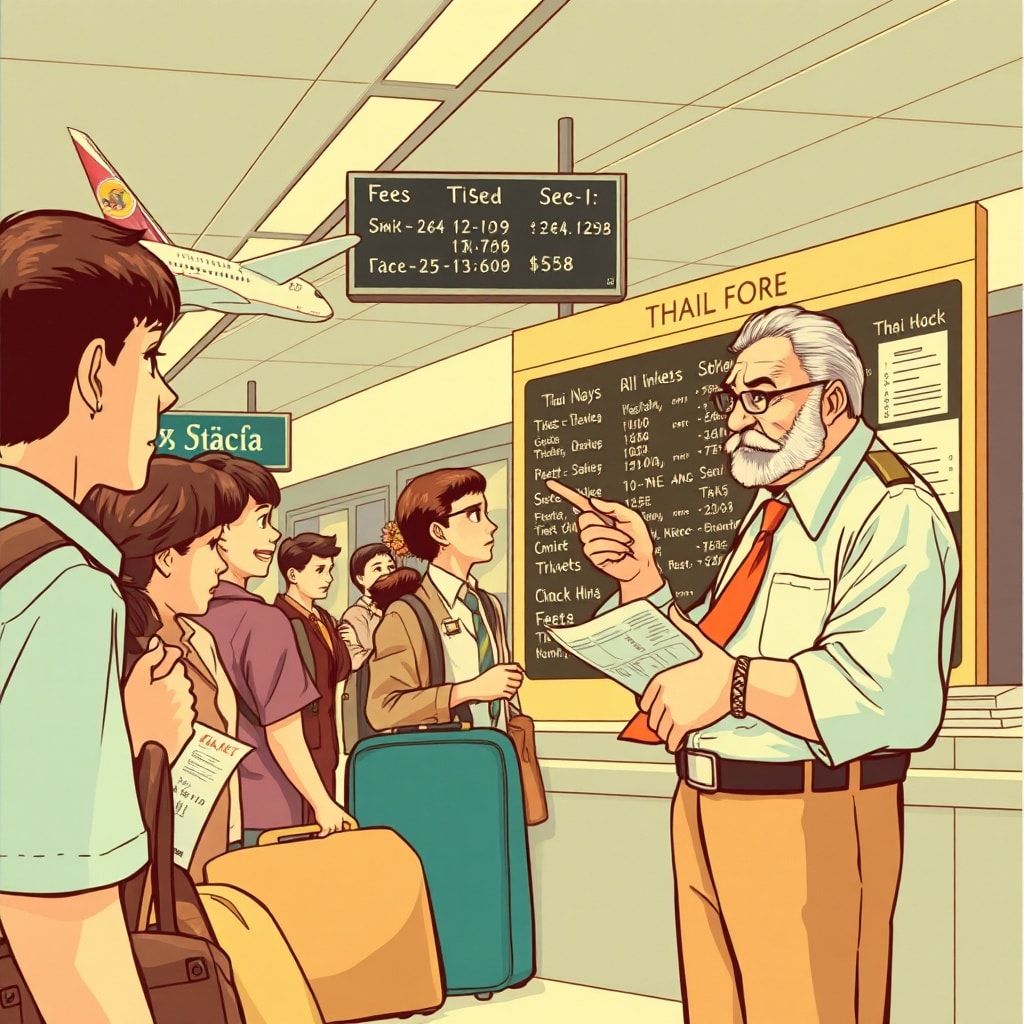
The Thai Airways “Stand‑by Upgrading surcharge/ Fee” table spells out cash fees that most travelers overlook. On the Bangkok ↔ Phuket sector, moving from Economy (Y/B) to Business costs THB 2,100, while mid‑tier fare classes (M/H/Q/T/K) incur THB 2,200, and premium fare classes (S/V/W) jump to THB 3,300. These numbers are not arbitrary; they reflect the airline’s revenue‑management calculus, rewarding higher‑priced tickets with lower upgrade penalties to preserve margin.
For international legs, the surcharge varies dramatically. Bangkok ↔ Singapore sees a modest THB 2,100 for Y/B but spikes to THB 5,500 for M/H/Q/T/K and THB 7,600 for S/V/W. The Bangkok ↔ Hong Kong route is even steeper, with THB 3,600 for Y/B, THB 8,700 for mid‑tier, and THB 10,800 for premium classes. This tiered structure mirrors demand elasticity: short‑haul routes keep fees low to encourage upgrades, while long‑haul routes charge premium for the added cabin service.
First‑class upgrades are a different beast. Since First Class cabins only exist on long‑haul flights, the Bangkok ↔ London ↔ Phuket corridor charges € 1,235 (≈ THB 41,800) for Y/B, € 1,655 (≈ THB 57,000) for M/H/Q/T/K, and € 1,820 (≈ THB 61,600) for S/V/W. Converting euros to baht shows the sheer scale of the premium experience.
Mileage‑based upgrades add another layer. To jump from Economy Y/B to Premium Economy on Phuket ↔ Singapore you need 12,000 Royal Orchid Plus miles; Business requires 15,000 miles, while a Sydney Business upgrade demands 28,000 miles, and a First‑Class leap to Zurich/Paris/London costs 31,500 miles. However, fare classes T, K, S, Z, G, V, W, and L are locked out of any upgrade, and the airline excludes industry‑discount, agent‑discount, ZED, barter, and ROP redemption tickets from surcharge eligibility.
All upgrades must be processed either at the departure‑airport check‑in counter (cash) or via the My Booking portal (miles) at least 24 hours before departure. This timing rule prevents last‑minute revenue spikes and gives the airline a buffer to manage cabin inventory.
For the original source, see the official project page.
Historical Context – The Old Guard Perspective

Back in the early 2000s, Thai Airways operated a far simpler upgrade model. Stand‑by cash fees were flat – typically THB 1,500 regardless of fare class – and mileage upgrades required a single tier of 10,000 miles for any cabin jump. The airline’s fare‑class matrix was limited to Y, B, and a handful of premium codes, making the upgrade decision a straightforward cost‑benefit analysis.
The shift began when low‑cost carriers entered the Thai market, forcing legacy airlines to segment their product more aggressively. Thai Airways introduced a broader palette of fare codes (M, H, Q, T, K, S, V, W) to differentiate price points and lock in revenue streams. This stratification allowed the carrier to charge higher surcharges for higher‑priced tickets, a practice common among full‑service airlines worldwide.
Simultaneously, the rise of online booking platforms in the late 2000s gave travelers unprecedented visibility into fare structures. Passengers could now compare the cost of a direct Business ticket versus an Economy ticket plus a standby upgrade fee. This transparency pressured airlines to justify their surcharge levels with tangible cabin benefits – better seats, meals, and lounge access.
The introduction of the Royal Orchid Plus frequent‑flyer program added another dimension. Early on, mileage upgrades were generous, but as the program matured, Thai Airways tightened redemption requirements to protect revenue. The exclusion of discount‑ticket categories (industry, agent, ZED) reflects a broader industry trend: protecting premium inventory from being cannibalized by low‑margin tickets.
In essence, the current upgrade fee landscape is a product of market competition, fare‑class proliferation, and loyalty‑program economics – a far cry from the blunt, one‑size‑fits‑all approach of the early 2000s.
Technical Crunch – Information Gain
Understanding the mechanics behind Phuket flight costs requires dissecting three core variables: fare class, route distance, and upgrade method. Fare class determines the base surcharge tier – Y/B (lowest), M/H/Q/T/K (mid), S/V/W (high). The route distance influences the absolute fee: short‑haul domestic legs (Bangkok‑Phuket) keep cash fees under THB 3,500, while long‑haul international legs (Bangkok‑London) push fees into the euro‑range.
The upgrade method adds another layer. Cash upgrades are processed at the check‑in counter, subject to the 24‑hour rule, and the surcharge is applied directly to the ticket price. Mileage upgrades, on the other hand, deduct from a member’s Royal Orchid Plus balance and are only available through the My Booking portal, also respecting the 24‑hour deadline. The mileage cost varies dramatically: 12,000 miles for a short‑haul Premium Economy jump versus 31,500 miles for a First‑Class leap on a European route.
Eligibility rules are strict. Fare classes T, K, S, Z, G, V, W, and L are locked out of any upgrade, effectively making them “premium‑only” tickets. This protects the airline’s revenue by preventing a low‑cost ticket from being upgraded at a discount. Moreover, tickets issued under industry‑discount, agent‑discount, ZED, barter, or ROP redemption programs are excluded from surcharge applicability, ensuring that corporate or barter deals don’t become loopholes for cheap upgrades.
From a revenue‑management perspective, these rules allow Thai Airways to maximize ancillary income. By charging higher surcharges on higher‑priced fare classes, the airline extracts additional profit from passengers who are already willing to pay more. Simultaneously, the mileage redemption thresholds are calibrated to preserve the value of the loyalty program while still offering a path for frequent flyers to enjoy premium cabins.
For the savvy traveler, the key takeaway is to plan ahead: book a fare class that is upgrade‑eligible, calculate the cash versus mileage cost, and execute the upgrade at least 24 hours before departure to avoid last‑minute price spikes.
The next decade promises a seismic shift in how Phuket flight costs are presented and managed. Digital transformation is already enabling dynamic, real‑time surcharge calculations based on AI‑driven demand forecasts. Travelers may soon see a live “upgrade barometer” on booking platforms, showing the exact cash or mileage cost for the next 24‑hour window.
Competition from regional low‑cost carriers will force Thai Airways to either lower its surcharge tiers or bundle upgrades into premium bundles that include lounge access, extra baggage, and priority boarding. Such bundles could simplify the decision‑making process, turning a fragmented surcharge landscape into a single, transparent price point.
Loyalty programs are also evolving. The Royal Orchid Plus scheme is likely to introduce tiered mileage multipliers for upgrades, rewarding elite members with reduced mileage costs or even free upgrades on select routes. This could shift the balance from cash‑based upgrades to mileage‑centric strategies, especially for frequent flyers.
Regulatory scrutiny may also play a role. Consumer protection agencies in Thailand and the EU are increasingly demanding clearer disclosure of ancillary fees. We may see mandatory upfront display of upgrade surcharges on all marketing materials, eliminating the surprise factor that currently haunts many travelers.
Listen up, green‑horns. The moment you think you’ve cracked the Phuket flight cost code is the moment the airline rolls out a new fee tier you didn’t see coming. I’ve watched the same surcharge model get a fresh coat of paint every time a budget carrier sneaks into the market, and the only thing that stays constant is the airline’s love for extracting every baht they can. Your best weapon is foresight: lock in an upgrade‑eligible fare, crunch the cash‑vs‑miles numbers, and hit the counter early. Miss that window and you’ll be paying THB 3,300 for a seat that feels like a cramped economy with a fancy label.
Don’t be fooled by glossy promotional videos promising “luxury for less.” Those are just smoke screens for a complex web of fare‑class restrictions, exclusion clauses, and last‑minute price spikes. The veteran traveler knows that the real savings lie in the fine print – the standby surcharge tables, the mileage redemption charts, and the 24‑hour rule that can turn a cheap ticket into a pricey upgrade nightmare. Keep your receipts, track your miles, and never, ever assume a discount ticket can be upgraded. If you do, you’ll end up with a seat that’s half‑business, half‑budget, and wholly disappointing.
Check out the Phuket flight costs archives.