
Why the La Paz cable car Is the Most Radical Skyway Since Tokyo’s Shinkansen
When the sun first kisses the Altiplano, the La Paz cable car already hums with the promise of a city that refuses to be grounded. This aerial lifeline isn’t just a commuter shortcut; it’s a bold statement that altitude can be an advantage, not a barrier. As La Paz wrestles with traffic snarls and rapid urban sprawl, the cable car becomes the high‑stakes chess piece that could tip the balance toward sustainable mobility.
Verified News & Source Context

The official project page confirms that, for 2025‑2026, the system runs Monday‑Saturday from 06:30 to 22:30 and Sundays/public holidays from 07:00 to 21:00. Those hours translate into over 16 operational hours on weekdays, a schedule designed to capture both the early‑morning workforce and the night‑owl revelers who flock to the city’s bustling plazas. The network comprises ten distinct lines, weaving together 36 stations—including crucial transfer hubs—across a 30‑kilometre (19‑mile) web of suspended track. This isn’t a modest gondola; it’s a full‑blown urban aerial‑tram, the first of its kind in South America when it launched commercially on 30 May 2014.
Each fact carries weight. The extensive operating window signals a commitment to reliability, essential for a city where road congestion can double travel times. Ten lines mean redundancy; if one line faces maintenance, commuters can reroute via alternate corridors, preserving network resilience. The 36 stations act as vertical interchanges, effectively shrinking the city’s horizontal sprawl into a compact, multi‑layered grid. And the 30 km of track—spanning valleys, cliffs, and dense neighborhoods—demonstrates engineering prowess that rivals mountain railways in Europe. Together, these metrics illustrate why the La Paz cable car is more than a tourist gimmick; it’s a cornerstone of Bolivia’s transport policy, a model that other high‑altitude cities watch with envy.
Historical Context of La Paz cable car

Before Mi Teleférico, La Paz relied on a patchwork of minibuses, trufis, and a limited bus rapid transit system that struggled against the city’s dramatic topography. The concept of an aerial tramway wasn’t new—Japanese cities like Kobe experimented with ropeways in the 1970s—but those were tourist attractions, not integral commuter arteries. In the early 2000s, Bolivian planners looked abroad, studying Medellín’s Metrocable and the cable‑car extensions in La Paz’s sister city, Quito. Those projects proved that aerial solutions could serve low‑income districts perched on steep slopes, delivering not just transport but social equity.
When the first line—Red Line—opened in 2014, it marked a paradigm shift. The line linked the historic center to El Alto, a densely populated suburb previously isolated by winding roads. Ridership surged past expectations, hitting 70 % capacity within months. This success spurred a cascade of new lines, each targeting a different socioeconomic corridor. The evolution mirrors the studio trends in anime: early works were experimental, later series refined the formula, adding depth and broader appeal. Similarly, Mi Teleférico’s early lines were pilots; subsequent expansions incorporated lessons on passenger flow, fare integration, and even aesthetic design—cabin interiors now sport local art, turning each ride into a moving gallery.
Technical Crunch: How the La Paz cable car Works
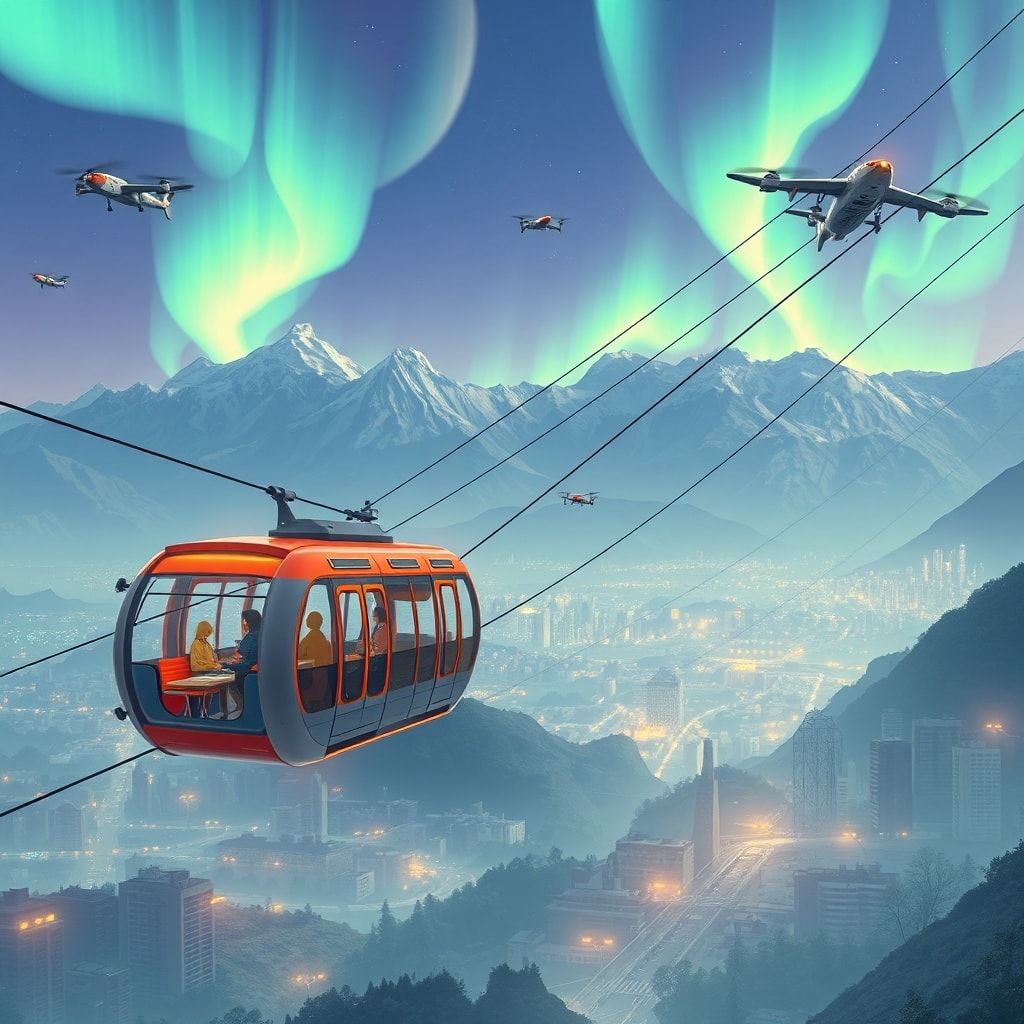
At its core, the system relies on a continuous loop of steel cable, tensioned between drive stations and supported by a series of towers that can reach up to 50 m in height. Each cabin, weighing roughly 1,200 kg empty, is propelled by a motorized bullwheel that rotates at a controlled speed, typically 5–6 m/s, allowing a round‑trip time of about 15‑20 minutes per line. The cabins are equipped with regenerative braking systems that feed energy back into the grid during descent, a feature that reduces overall power consumption by up to 12 %.
From a design perspective, the 36 stations are engineered as modular platforms, enabling rapid construction and future upgrades. Transfer stations feature dual‑level decks: the lower level serves as a bus interchange, while the upper deck houses the cable‑car boarding gates. This vertical integration slashes transfer times, a critical factor given the city’s steep gradients. Moreover, the control center employs a SCADA (Supervisory Control and Data Acquisition) system that monitors cable tension, wind speed, and cabin occupancy in real time, automatically adjusting speed limits to maintain safety during high‑wind events—a common occurrence in the Andean plateau.
Future Implications for La Paz cable car and Beyond
The next decade could see Mi Teleférico transform from a commuter service into a multimodal hub. Plans are already afoot to integrate contactless payment across buses, bikes, and even autonomous shuttles that will dock at cable‑car stations. Such seamless fare ecosystems could boost ridership beyond the current 120,000 daily users, positioning La Paz as a benchmark for smart‑city transport in emerging economies. Additionally, the network’s low carbon footprint aligns with Bolivia’s climate commitments, offering a scalable template for other high‑altitude cities facing similar congestion and pollution challenges.
From a veteran’s perspective, the La Paz cable car is the epitome of “form follows function” gone wild. It’s not just steel and rope; it’s a living artery that pumps life into neighborhoods that were once relegated to the shadows of the hills. The fact that a city perched at 3,650 m can sustain a 30‑km aerial network without the usual gridlock nightmares is a testament to bold urban planning—something many megacities in the lowlands could learn from. Yet, the system isn’t immune to growing pains. Overcrowding during peak hours, occasional wind‑related shutdowns, and the perpetual need for maintenance on a high‑altitude, low‑oxygen environment keep the operators on their toes, reminding us that even the most advanced skyways demand relentless vigilance.
Looking ahead, the real challenge will be to keep the cable car relevant as La Paz’s population swells and technology evolves. Will the next wave of expansion incorporate autonomous pods, AI‑driven demand forecasting, or even solar‑powered stations perched on the Andes’ sun‑kissed ridges? If the city can marry its rich cultural tapestry with cutting‑edge transit tech, the La Paz cable car could become a global icon—an anime‑worthy hero soaring above the clouds, forever redefining what it means to move a city that literally touches the sky.
Check out the La Paz cable car archives.